




Introduction
In the aluminum electrolysis industry, the efficient handling and stacking of anode carbon blocks is a critical operation that directly impacts production capacity, operational safety, and overall plant efficiency. The anode carbon stacking overhead crane is a specialized lifting solution designed precisely for this demanding task. This specialized overhead crane serves as the backbone of material handling in carbon plants and aluminum electrolysis facilities, enabling seamless transport, stacking, and retrieval of green and baked anode carbon blocks.
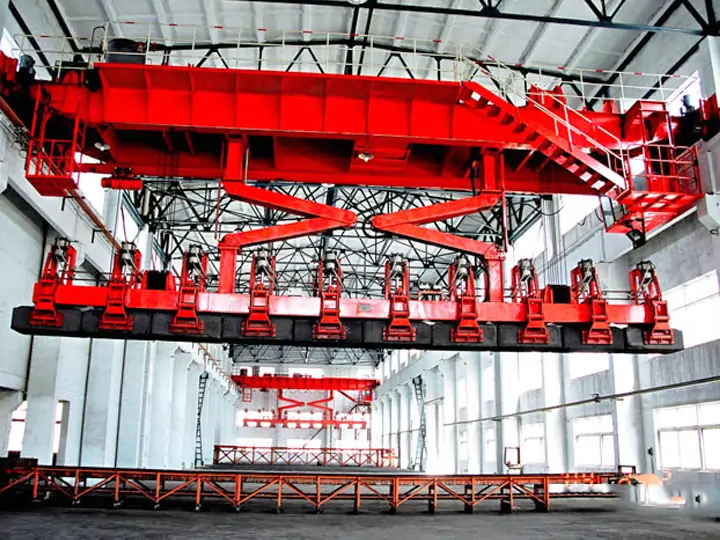
Anode carbon block stacking overhead cranes are specialized transfer equipment used in carbon block warehouses of carbon plants, primarily designed for stacking and transporting green anode blocks, baked anode blocks, and rodded anode blocks—typically handled in groups of 19 or 21 blocks per cycle. These cranes can achieve stacking heights of up to 8 layers, maximizing warehouse space utilization while minimizing manual intervention.
This comprehensive guide explores everything you need to know about anode carbon stacking overhead cranes, including their working principles, key components, automation features, applications, and the latest industry trends shaping the future of carbon block handling.
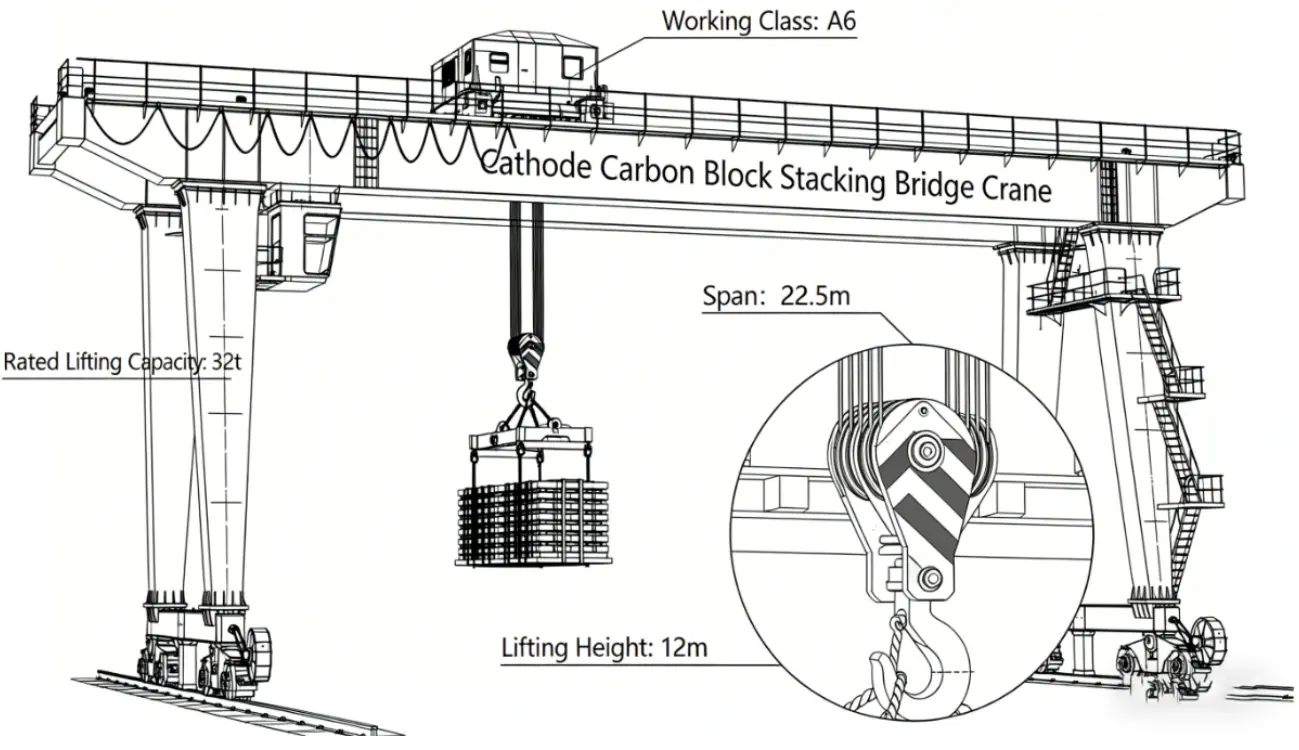
What Is an Anode Carbon Stacking Overhead Crane?
An anode carbon stacking overhead crane is a purpose-built bridge crane designed specifically for handling anode carbon blocks in the aluminum production supply chain. Unlike standard overhead cranes, these specialized units are engineered with integrated clamping systems capable of gripping multiple carbon blocks simultaneously, transferring them between production stages, and stacking them in organized warehouse layouts.
The crane essentially acts as a bridge between various stages of the carbon anode production process—from the forming and baking stages to storage and final delivery to the electrolysis cells. By automating the movement and stacking of these heavy, fragile carbon blocks, the equipment plays a vital role in maintaining continuous production flow while reducing product damage and labor costs.
Key Terminology
The industry uses several terms interchangeably to describe this equipment:
Anode carbon stacking overhead crane — The most comprehensive technical term
Anode carbon block stacking crane — Commonly used in technical specifications
Carbon block stacker crane — Shorter, industry-familiar term
Anode stacking crane — Widely used in aluminum smelting contexts
Core Components and Structural Composition
Understanding the structural composition of an anode carbon stacking overhead crane is essential for proper selection, operation, and maintenance. The crane consists of several interconnected systems working in harmony:
1. Bridge Frame and Traveling Mechanism
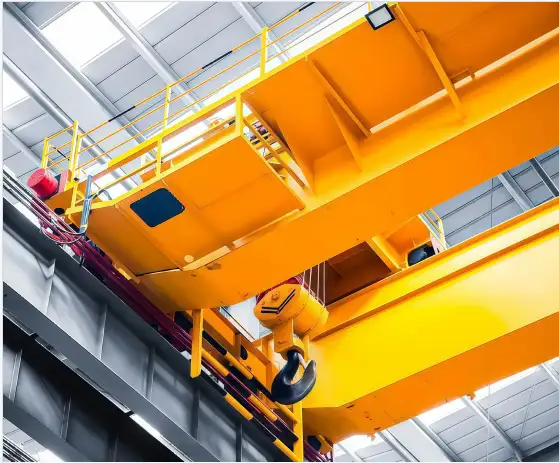
The bridge frame serves as the main structural backbone of the crane. It comprises two primary girders (typically welded box-beam construction) connected by end carriages. The entire bridge travels along rails mounted on the workshop columns, enabling longitudinal movement across the warehouse. Key characteristics include:
High-rigidity box beam structure designed to withstand heavy loads and torsional forces
Dual-drive traveling mechanism with variable frequency drive (VFD) control for smooth acceleration and deceleration
Anti-torsion end beam assemblies that maintain structural integrity during operation
Span range: Typically 13.5 m to 34.5 m, with common configurations at 16.5 m and 19.5 m
2. Hoisting and Lifting Mechanism
The hoisting mechanism is responsible for raising and lowering the clamp assembly and its carbon block load. This system is engineered for precision and safety:
Main winch mechanism with dual-brake configuration for fail-safe operation
4:1 reeving system using movable and fixed pulley blocks to multiply lifting force
Balance sheaves that ensure uniform wire rope tension across all lifting points
Lifting speed: Typically 2.5–6 m/min (VFD-controlled)
Lifting capacity: 16–27 tons depending on configuration and clamp type
3. Guiding and Stabilization System
Given the considerable length of the clamp assembly (up to 14 meters), guiding systems are essential to prevent swinging and ensure accurate positioning during lifting and lowering operations. Two primary guiding configurations exist:
Cylindrical guide rod system — Traditional design using vertical guide rods
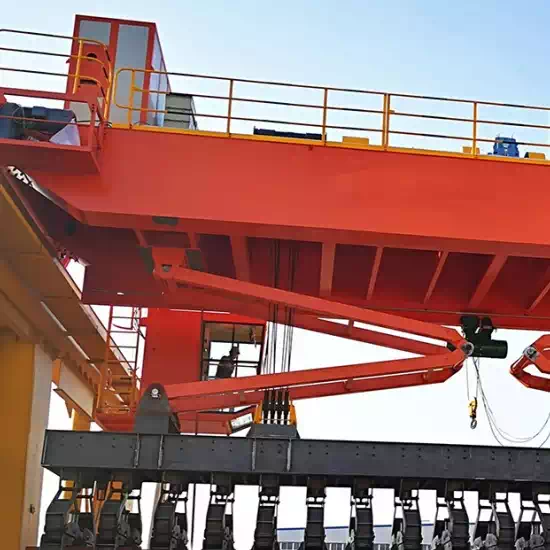
Folding steel structure — More modern approach with articulated upper and lower sections that eliminates the need for cable and air hose reels, reducing maintenance requirements and allowing lower building clearances
4. Electric Hoist (Auxiliary Lifting)
Most anode carbon stacking cranes include a supplementary electric hoist mounted on an I-beam along the bridge. This auxiliary lifting device serves several purposes:
Handling single carbon blocks for quality control or defect replacement
Lifting maintenance tools and miscellaneous items
Positioning at speeds of 8–20 m/min with lifting capacity typically 2–5 tons

Working Principle: How the Stacking Crane Operates
The operational sequence of an anode carbon stacking overhead crane is a precisely choreographed process managed by programmable logic controllers (PLC) and sensor feedback systems.
Basic Operating Cycle
Positioning — The crane travels along its rails to align over the target carbon block group. Laser positioning or encoder systems provide vertical coordinate data with accuracy of ±2 mm.
Descent and Detection — The main winch lowers the clamp assembly toward the carbon block row. Load cells and rope tension sensors monitor the descent continuously.
Clamp Engagement — Upon detecting the "loose rope" signal (indicating proper seating on the blocks), the clamping mechanism activates. In pneumatic systems, compressed air drives the cylinders; in mechanical systems, gravity and linkage geometry produce the gripping force.
Weight Verification — Load weighing modules with 0.5% accuracy confirm that the intended number of blocks has been successfully gripped. This validation step prevents partial loads from being lifted.
Lifting and Transport — With verification complete, the main winch lifts the clamped load to the upper limit. The crane then travels to the designated stacking or unloading position.
Stacking or Placement — The crane lowers the load onto the target position, guided by the positioning system and anti-sway controls for precise alignment.
Release and Return — The clamps open, releasing the blocks, and the crane returns to its starting position for the next cycle.
Automated Functions
Modern anode carbon stacking cranes incorporate sophisticated automation capabilities:
Automatic detection of clamp leakage and wear conditions
Closed-circuit monitoring for remote observation of operations
Adaptive stacking height calculation to prevent over-stacking
Fault self-diagnosis with real-time alerts and logging
Key Advantages and Benefits
1.Productivity Enhancement
Bulk handling capacity: Gripping 19–21 blocks per cycle versus 1–2 blocks with conventional equipment dramatically increases throughput
Reduced cycle times: VFD-controlled motions with optimized acceleration/deceleration profiles minimize non-productive time
Continuous operation capability: Heavy-duty A7–A8 duty classification supports 24/7 operation in demanding environments
2.Labor Savings and Safety
90% reduction in manual labor intensity reported in fully automated installations
Removal of operators from hazardous environments — carbon dust, hydrocarbon fumes, and high-temperature zones
Built-in safety features include limit switches, emergency stops, overload protection, and anti-sway control modules
3.Space Optimization
6–8 layer stacking height dramatically increases warehouse capacity per square meter
Reduced aisle width requirements due to precise positioning systems
Lower building height potential with folding guide designs
4.Energy Efficiency
Mechanical gravity clamps consume no electrical power during gripping operations
VFD technology reduces energy consumption by 20–30% compared to traditional motor control methods
Regenerative braking options available on some configurations
5.Maintenance Advantages
Lubrication-free bearing design on clamp mechanisms
Modular construction enables rapid component replacement
Visual wear indicators simplify preventive maintenance scheduling
Average maintenance time under 30 minutes for clamp servicing
Conclusion
The anode carbon stacking overhead crane represents a critical investment for any carbon plant or aluminum smelter seeking to optimize material handling operations. From its specialized clamping mechanisms that grip 19–21 blocks simultaneously to its sophisticated PLC-controlled automation systems that enable unmanned operation, this equipment delivers measurable improvements in productivity, safety, and space utilization.
Whether you are designing a new carbon plant, upgrading an existing facility, or simply seeking to improve warehouse efficiency, understanding the capabilities and benefits of anode carbon stacking overhead cranes is the first step toward a more productive future.
ZEHUA is a leading crane manufacturer in China. With decades of industry experience, we have become a trusted partner in the global material handling solution field. We are committed to providing comprehensive professional services tailored to your specific needs. We recommend the most suitable crane products, offer accurate quotations, and design customized solutions. Welcome to contact us.
HENAN ZEHUA HEAVY INDUSTRY EQUIPMENT CO., LTD
Email: sale@zehuacranes.com
Website: [https://www.zehuacranes.com/]
Whatsapp:86-19562739544


