




How Does a ZEHUA MQ Portal Crane Work? What is a Portal Crane?
In the bustling world of global trade, port efficiency is paramount. At the heart of many busy terminals, you'll find the versatile and robust workhorse: the Portal Crane. This blog post dives deep into the ZEHU MQ series, explaining what a portal crane is, how it works, and why it's a cornerstone of modern port operations.
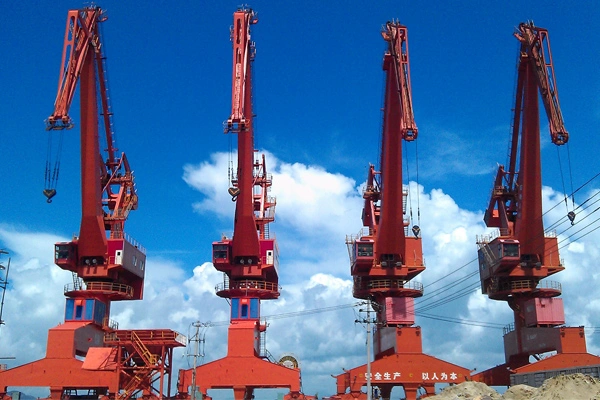
What is a Portal Crane?
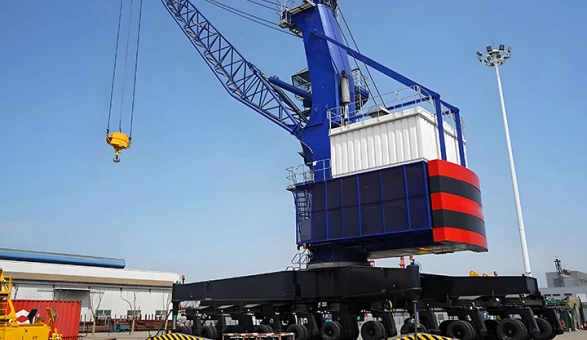
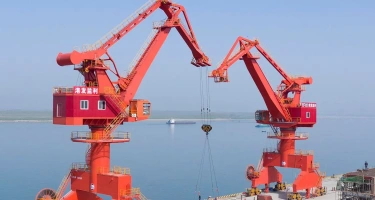
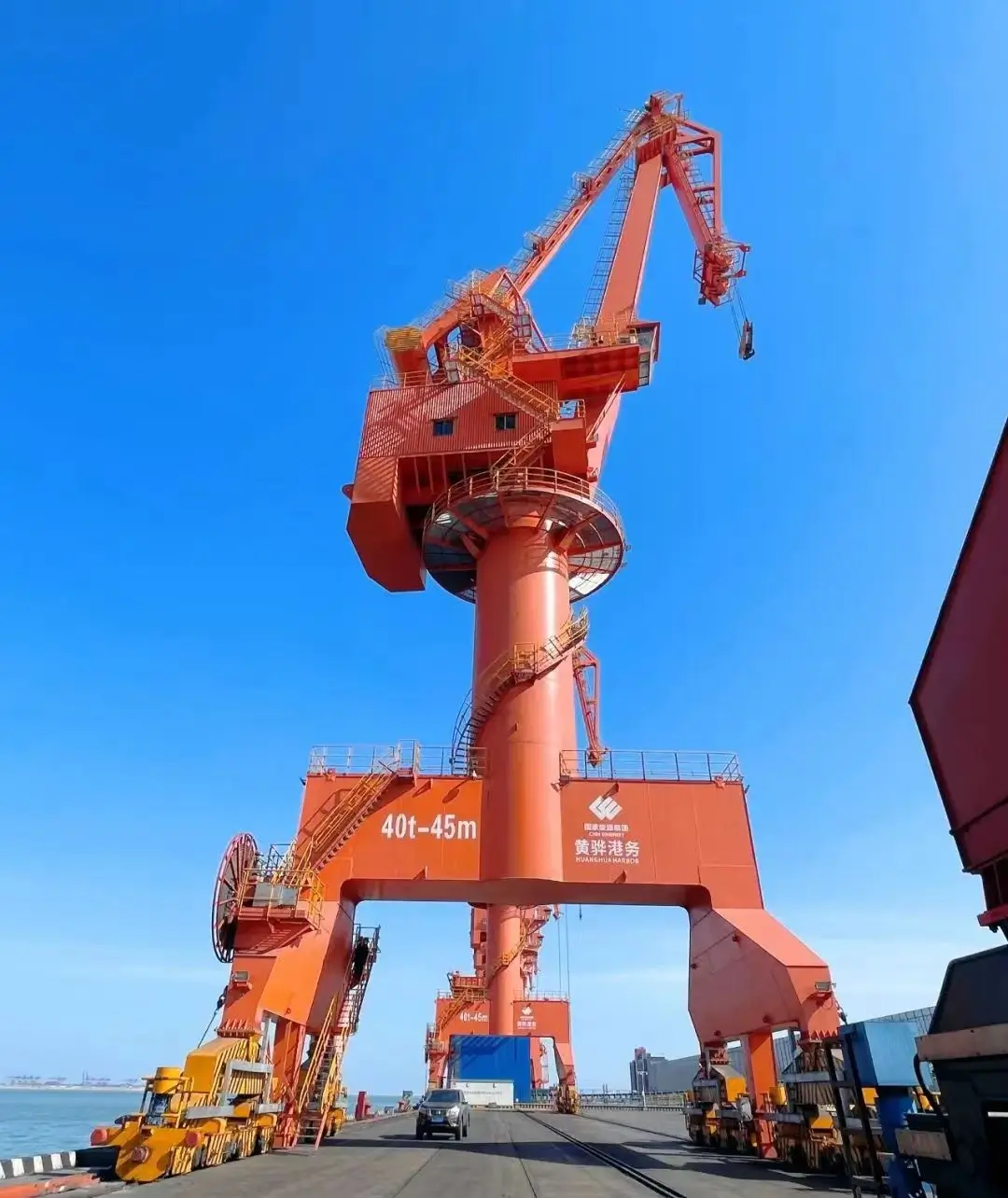
A Portal Crane, often called a "portal crane" or "gantry crane," is a type of rail-mounted, slewing jib crane. Its distinctive feature is a gantry-shaped base that resembles a gate or portal, hence the name. This design allows the crane to traverse along rails on the ground while its revolving superstructure performs lifting operations. Crucially, the large opening under the portal enables the passage of railway trains, trucks, and other vehicles, facilitating direct transshipment between ship and land transport.
Portal cranes are renowned for their aesthetic design, operational safety, advanced performance, ease of maintenance, and durability. They are widely used in ports for cargo handling, shipyards for construction and installation, and large hydropower station projects. As a traditional and highly adaptable solution for waterfront operations, they remain the most numerous primary crane type in many bulk and general cargo terminals.
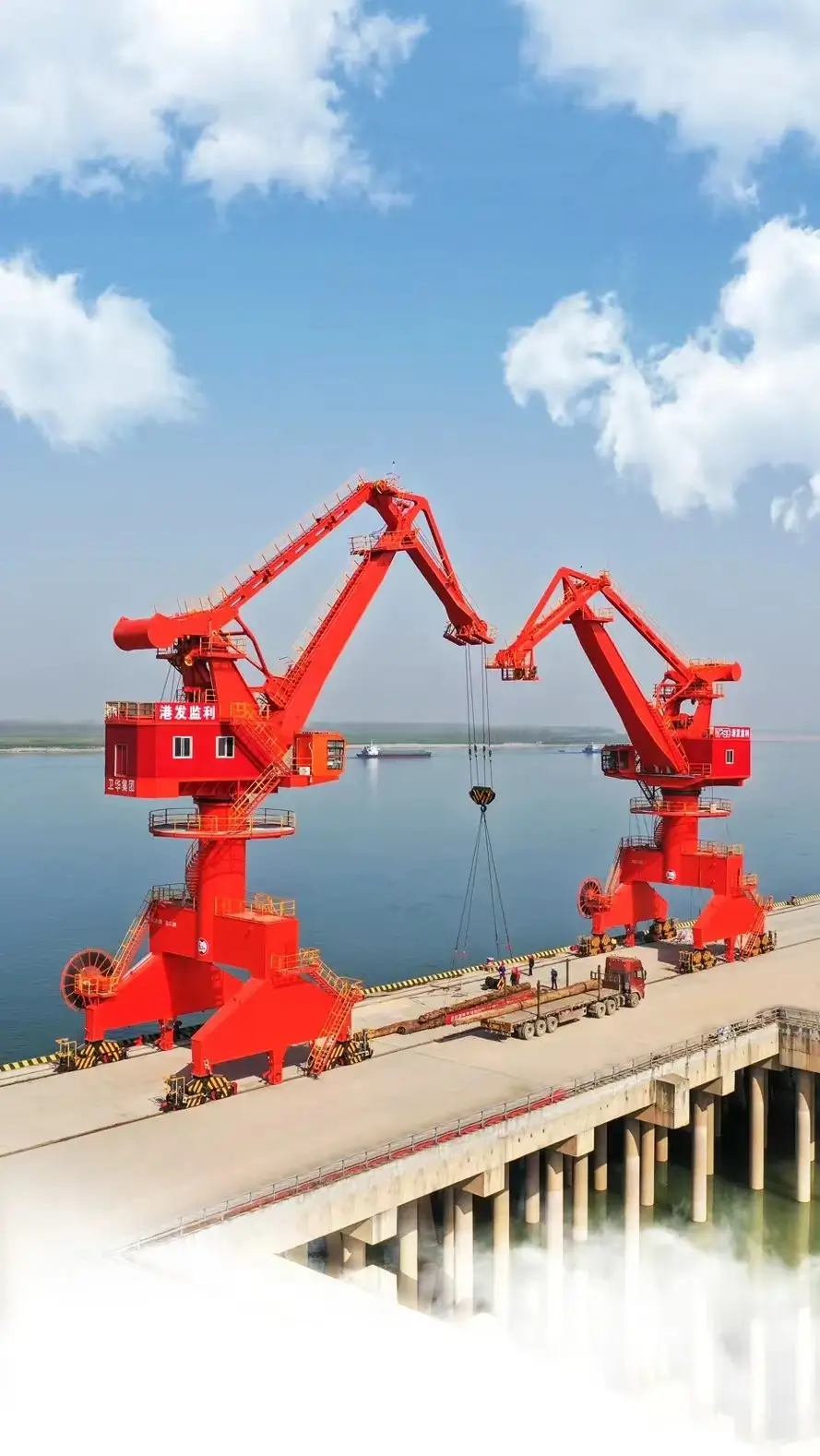
Common Classifications of Portal Cranes:
Portal cranes are categorized based on several key structural features:
By Gantry Structure:
Full Portal Crane: Features a complete gantry structure with both legs running on tracks at the same level.
Semi-Portal Crane: Lacks a full gantry; one leg runs on a ground-level track, while the other runs on a track mounted on a warehouse or special trestle.
-
Hopper-Type Portal Crane: This specialized crane integrates a hopper and conveyor system, combining the functions of a standard portal crane, ship loader, and unloader. It offers higher automation, superior efficiency, lower energy consumption, and reduced environmental pollution for bulk materials. Its compact design, smaller footprint (e.g., 10.5m rail gauge), and ability to handle both bulk and general cargo make it highly versatile and in growing demand.
By Boom Structure:
Dual Four-Bar Linkage Boom: An innovation for container handling. It adds a secondary, smaller linkage system to the main boom. This configuration keeps the spreader stable, preventing tilt and swing during operation, and enables efficient handling of containers, grab buckets, and hooks, making it a true multi-purpose crane.
Four-Bar Linkage (FBL) Boom: The most common type, providing a large clearance height under the boom for a relatively low overall crane height. It offers stable load movement.
-
Single Boom: Simpler in structure but generally offers less favorable load path characteristics compared to the FBL design.
By Slewing Bearing Type:
Column-mounted (Fixed or Rotating Column)
Roller Circle (Large Bearing)
While traditional types like column-mounted are prevalent, large-diameter bearing types are gaining traction due to their compact design and reduced weight.
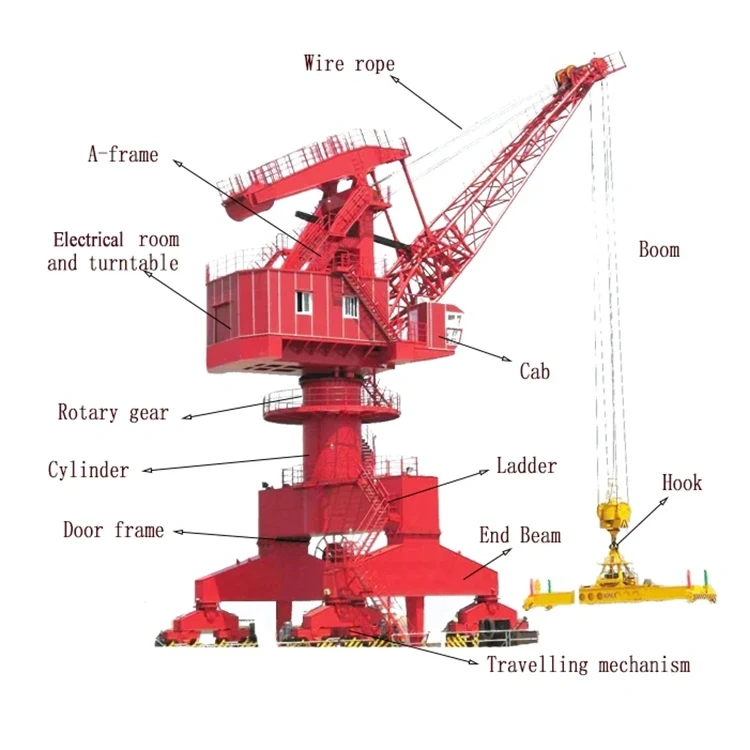
Structure: Includes the boom system, A-frame, slewing platform, cabin, and the iconic portal gantry.
Mechanisms: Comprises the four – Hoisting, Luffing (derricking), Slewing, and Traversing.
Electrical System: Typically powered via cable reel or conductor rails, using AC frequency control for smooth operation.
Safety Systems: Features limit switches, load moment indicators, buffers, and storm-proof securing devices.
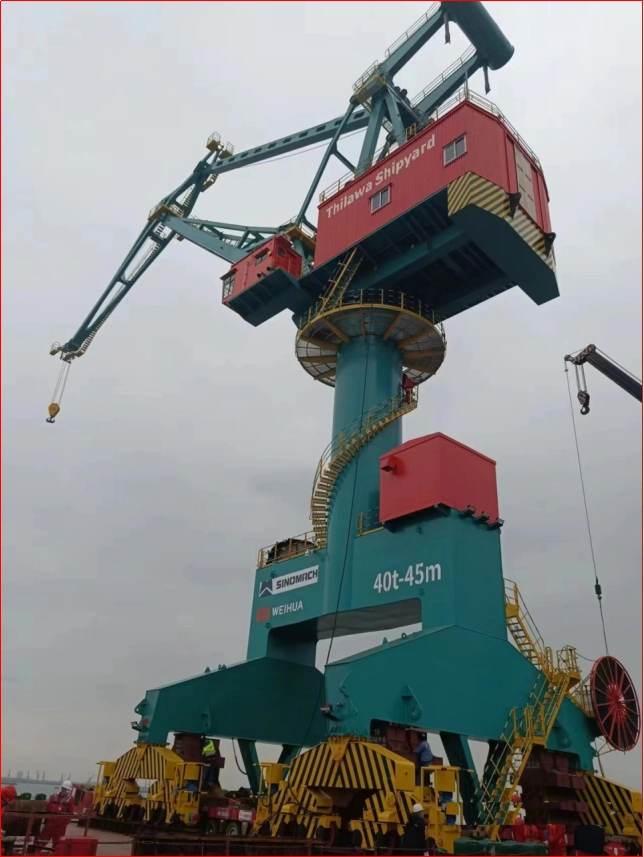
Core Parameters, Structural Features & Advantages
A portal crane's performance is defined by key parameters like lifting capacity (e.g., 5-100T, up to 300T for shipbuilding), outreach, lifting height, and hoisting speed (up to 70 m/min).
Structural Breakdown & Key Innovations:
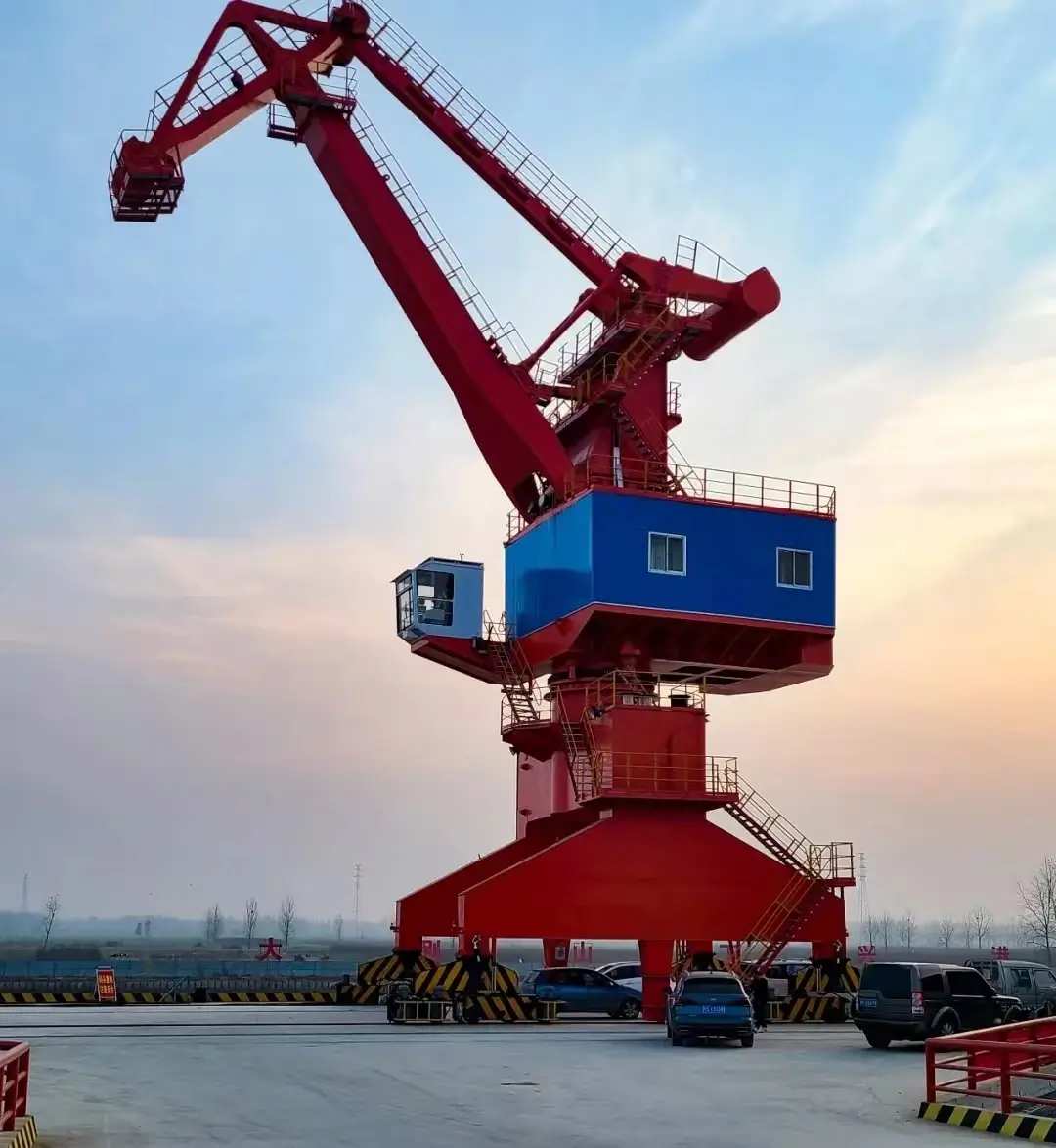
The ZEHUA Advantage: Dual Four-Bar Linkage & Container Handling
ZEHU's MQ series, particularly models with the dual four-bar linkage system, represents a significant technological leap.
Dual Four-Bar Linkage System: This system consists of a main linkage (main boom, tie-rod, "elephant's trunk") and a smaller secondary linkage. The hoist ropes are routed to create a trapezoidal arrangement over the spreader. This design automatically counteracts any tendency for the spreader to swing or tilt, ensuring precise and stable positioning. This dramatically increases container handling efficiency, achieving rates up to 22 moves per hour. Furthermore, by bypassing the secondary linkage, the crane can seamlessly switch back to using standard hooks or grabs for other cargo, ensuring true multi-purpose functionality.
Advanced Container Spreader: ZEHU cranes can be equipped with a fully automated, telescopic, and slewing spreader. It can rotate up to ±190°, with its control system synchronizing counter-rotation to the crane's slewing motion. This keeps the container parallel to the quay throughout the move, enabling fast and accurate spotting without manual assistance.
Economic & Environmental Benefits:
ZEHU portal cranes offer outstanding economic value. Their mature design and high level of component localization reduce initial investment and long-term maintenance costs. Compared to dedicated ship loaders/unloaders, they are more cost-effective to transport and install. Furthermore, by integrating features like hopper-fed conveyor systems for bulk materials or specialized tipping/flipping spreaders for containerized bulk, ZEHU cranes enable closed-loop, dust-free operations, aligning with the highest green port standards.
Application Scenarios
The ZEHU MQ Portal Crane's greatest strength is its exceptional adaptability. With the appropriate attachments (hook, grab, specialized spreaders), it can handle virtually every dry cargo type:
Bulk: Iron ore, coal, grain, bauxite
Breakbulk: Steel coils, timber, project cargo
General Cargo: Bagged goods, pallets
Containers: Efficiently handled with the dual FBL system
This versatility makes it the ideal choice for multi-purpose terminals, avoiding the limitations of single-purpose equipment. It can efficiently perform both loading and unloading operations, providing ports with unparalleled operational flexibility.
Common Faults & Proactive Solutions
Regular maintenance is key to longevity. Common issues and their mitigations include:
Slewing Bearing Wear: Due to slow-speed, high-load, and often oscillating motions. Solution: Implement regular vibration analysis and lubrication schedules to detect early signs of pitting or wear.
Hoist System Issues:
Motor/Bearing Overheating: Caused by overloading or inadequate cooling. Solution: Monitor temperatures and ensure proper ventilation.
Wire Rope Damage: Look for broken wires, excessive wear, or deformation. Solution: Conduct frequent inspections and replace ropes according to safety standards.
Brake Failure: Manifests as excessive clearance, worn linings, or load drifting. Solution: Perform routine brake adjustments and component replacements.
Environmental Protection: For harsh port conditions (salt, moisture, dust), ZEHU cranes are built with corrosion-resistant coatings, sealed electrical components, and IP-rated enclosures to ensure reliability.
Gantry Travel ("Crawler") Issues: Misalignment can cause "rail gnawing." Solution: Use automated travel alignment systems and monitor wheel bearing temperatures and pressures.
Conclusion
The ZEHUA MQ Portal Crane is a testament to intelligent, robust, and adaptable engineering. From its fundamental portal design to advanced innovations like the dual four-bar linkage, it delivers the efficiency, versatility, and reliability that modern ports demand. By choosing ZEHU, you are not just selecting a crane; you are investing in a comprehensive solution designed to optimize your terminal's productivity for decades to come.
Ready to enhance your port's capabilities? Contact ZEHUA today to discover how our MQ Portal Crane solutions can drive your success.
HENAN ZEHUA HEAVY INDUSTRY EQUIPMENT CO., LTD
Email: sale@zehuacranes.com
Website: [https://www.zehuacranes.com/]
Whatsapp:86-19562739544


