




Introduction
When selecting material handling equipment for heavy industrial applications, the configuration of the crane structure is just as critical as the lifting capacity. Among the most common yet often misunderstood distinctions in the world of gantry cranes is the difference between the Single Jib Portal Crane (often referred to as a single-girder or cantilever gantry) and the Four-Link Portal Crane (a sophisticated articulated mechanism used primarily in floating docks and specialized heavy-lift scenarios).
What is a Single Jib Portal Crane?
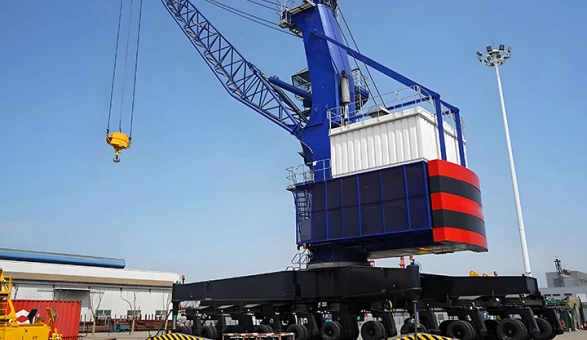
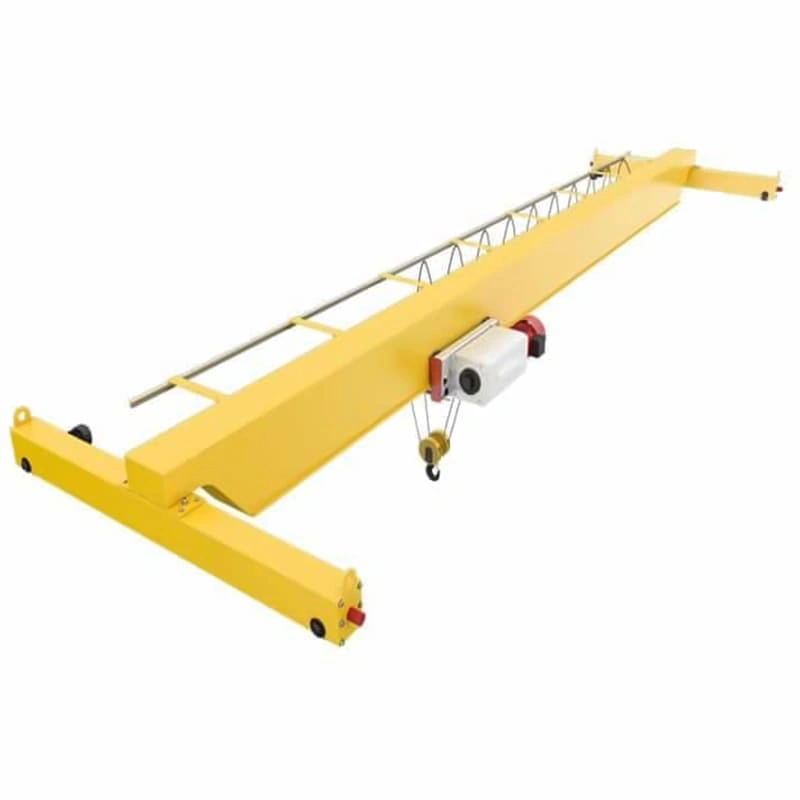
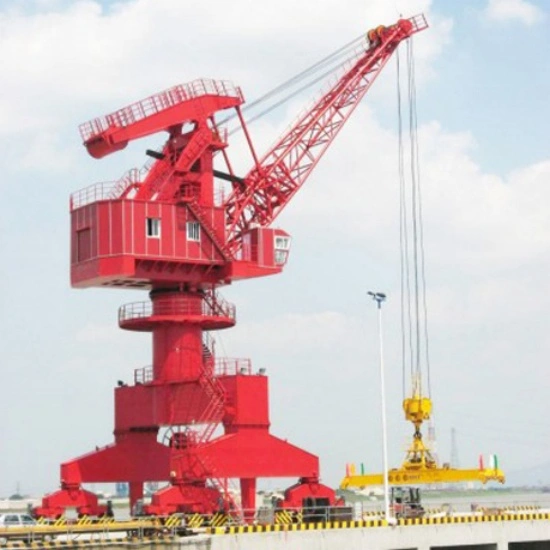
A Single Jib Portal Crane is characterized by a single boom (jib) that extends from a supporting structure, typically mounted on a gantry frame that moves on rails or wheels. This design relies on a straightforward cantilever principle.
Key Structural Features
Single Girder/Boom: The lifting mechanism runs along a single horizontal beam.
Simple Support Structure: Usually consists of two legs (A-frame or straight) that support the single beam.
Cantilever Design: The "jib" often extends beyond the support legs to provide outreach, allowing the hook to reach beyond the footprint of the crane’s wheels.
Advantages
Cost-Effective: Fewer materials and simpler fabrication make this the more economical choice.
Ease of Maintenance: With fewer moving parts and a straightforward load path, maintenance is generally simpler and less frequent.
Light to Medium Loads: Ideal for applications where precision is required but loads are moderate (typically under 50 tons).
Compact Footprint: The single-leg design often requires less structural steel, making it suitable for warehouses and container yards with limited infrastructure.
Limitations
Limited Outreach: While the jib provides outreach, the structural rigidity limits how far the load can extend without causing excessive deflection.
Torsional Stress: Under eccentric loading, the single beam experiences significant torsional (twisting) forces, which can reduce lifespan if overloaded.
What is a Four-Link Portal Crane?
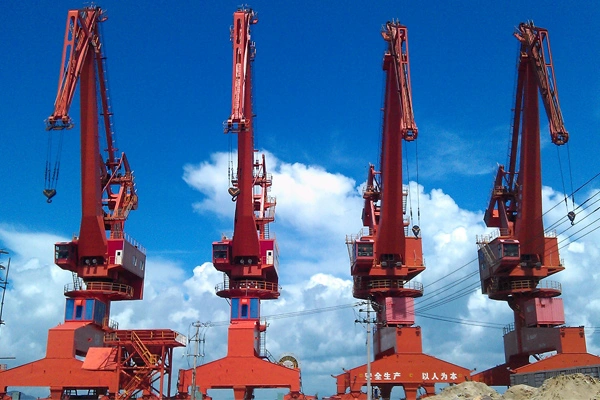
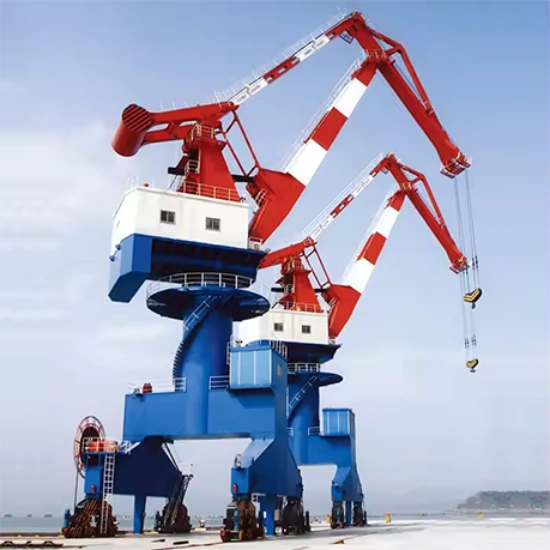
The Four-Link Portal Crane is a far more complex mechanical system. It utilizes a kinematic linkage system—often referred to as a "four-bar linkage"—to maintain the orientation of the load relative to the crane structure. This is most commonly seen in ship-to-shore gantry cranes, floating cranes, and heavy-lift dockyard cranes.
Key Structural Features
Articulated Mechanism: The system consists of four main links (typically the boom, the rocker, the frame, and the connecting rod) that pivot on bearings.
Luffing Mechanism: Unlike a simple jib that raises and lowers via a single cable, the four-link system uses a hydraulic or rack-and-pinion system to move the boom while keeping the load level or maintaining a specific hook path.
High Structural Redundancy: Designed with multiple pivot points and robust steel structures to handle massive dynamic loads.
Advantages
Superior Load Stability: The four-link geometry ensures that the hook remains level or follows a near-horizontal path during luffing (raising/lowering the boom). This is critical for precision placement of heavy or fragile items.
High Lifting Capacity: Typically designed for heavy to ultra-heavy loads (100 tons to several thousand tons).
Reduced Pendulum Effect: By controlling the geometry of the boom tip, these cranes minimize sway, making them safer in windy environments like ports.
Optimized Outreach: Allows for massive outreach (up to 60+ meters) without compromising structural integrity, essential for servicing large vessels.
Limitations
High Initial Investment: The complex engineering, high-grade materials, and precision bearings result in a significantly higher capital expenditure.
Specialized Maintenance: Requires skilled technicians familiar with kinematic analysis and hydraulic/mechanical linkage systems.
Head-to-Head Comparison: Single Jib vs Four-Link Portal Crane
To clarify the differences, let’s examine the two systems across critical engineering and operational metrics.
| Feature | Single Jib Portal Crane | Four-Link Portal Crane |
|---|---|---|
| Structural Complexity | Low. Simple cantilever design. | High. Articulated kinematic linkage. |
| Load Capacity | Light to Medium (1–50 tons typical). | Medium to Heavy (50–2,000+ tons). |
| Outreach | Limited. Deflection increases with reach. | Extensive. Maintains rigidity at long distances. |
| Hook Path | Arced path. Hook rises and falls as jib moves. | Near-linear/horizontal path. Ideal for precision. |
| Cost | Low to Moderate. | High. |
| Typical Applications | Warehouses, rail yards, precast concrete plants, light manufacturing. | Shipbuilding, dry docks, offshore wind turbine installation, heavy container ports. |
| Wind Resistance | Moderate. Subject to sway. | High. Typically designed with wind-locking mechanisms. |
Choosing the Right Crane for Your Application
When to Choose a Single Jib Portal Crane
Opt for a Single Jib Portal Crane if your operational requirements include:
Indoor or sheltered outdoor use: Where wind load is not the primary concern.
Modular loads: Such as loading/unloading steel coils, moving shipping containers in a yard, or handling precast concrete segments.
Budget constraints: You need a reliable solution without the overhead of complex hydraulics or electronics.
Frequent repositioning: If the crane needs to travel long distances on rails, the lighter weight of the single jib system reduces track wear and energy consumption.
When to Choose a Four-Link Portal Crane
The Four-Link Portal Crane is non-negotiable in scenarios involving:
Shipbuilding and Repair: When placing heavy engines, propellers, or superstructure components inside a vessel, the precision of the four-link mechanism prevents costly accidents.
Offshore Wind: Installing massive turbine components at sea requires a crane that can handle dynamic positioning and maintain level loads despite wave motion (when mounted on a vessel or floating platform).
High-Density Port Operations: Where rapid cycle times and the ability to reach across wide vessels (like Post-Panamax ships) are required.
Precision Heavy Lift: If your load must remain perfectly level during luffing to avoid damaging sensitive equipment or to facilitate precise bolt alignment.
Future Trends: Automation and Control Systems
Both crane types are benefiting from the rise of Industry 4.0, but the integration differs.
Single Jib Cranes are increasingly being retrofitted with smart sensors, load cells, and remote-control systems. Their simplicity makes them ideal for semi-automated warehouse environments where ROI is calculated on throughput.
Four-Link Cranes are becoming fully autonomous. In modern shipyards, these cranes are integrated with CAD/CAM systems. The crane "knows" the exact coordinates of the ship block it is lifting and can position it with millimeter precision without manual intervention, relying on the structural rigidity of the four-link design to maintain accuracy.
Conclusion
The choice between a Single Jib Portal Crane and a Four-Link Portal Crane is not merely a matter of budget—it is a strategic decision based on operational physics.
If your priority is cost efficiency, straightforward maintenance, and handling moderate loads in a controlled environment, the Single Jib Portal Crane is your optimal solution. Its simplicity is its strength.
However, if your operations demand extreme precision, massive lifting capacity, extensive outreach over water or obstacles, and the ability to handle dynamic loads safely, the Four-Link Portal Crane is the superior engineering choice. While the upfront investment is higher, the return on investment comes through reduced accident rates, faster cycle times, and the ability to handle mission-critical lifts that simpler cranes cannot perform
ZEHUA is a leading crane manufacturer in China. With decades of industry experience, we have become a trusted partner in the global material handling solution field. We are committed to providing comprehensive professional services tailored to your specific needs. We recommend the most suitable crane products, offer accurate quotations, and design customized solutions. Welcome to contact us.
HENAN ZEHUA HEAVY INDUSTRY EQUIPMENT CO., LTD
Email: sale@zehuacranes.com
Website: [https://www.zehuacranes.com/]
Whatsapp:86-19562739544


